Acoustic Water-Leak Localizer
A low-cost device that finds buried water leaks by listening from two points and correlating what it hears. Tuned specifically for plastic pipe, where the conventional correlators utilities already own tend to fail, and cheap enough that a municipality can own several without a specialist to run them.
Interactive demo
Move the leak · the correlator locates it from the two signals
…
The device
Two clamp-on sensors and a handheld unit
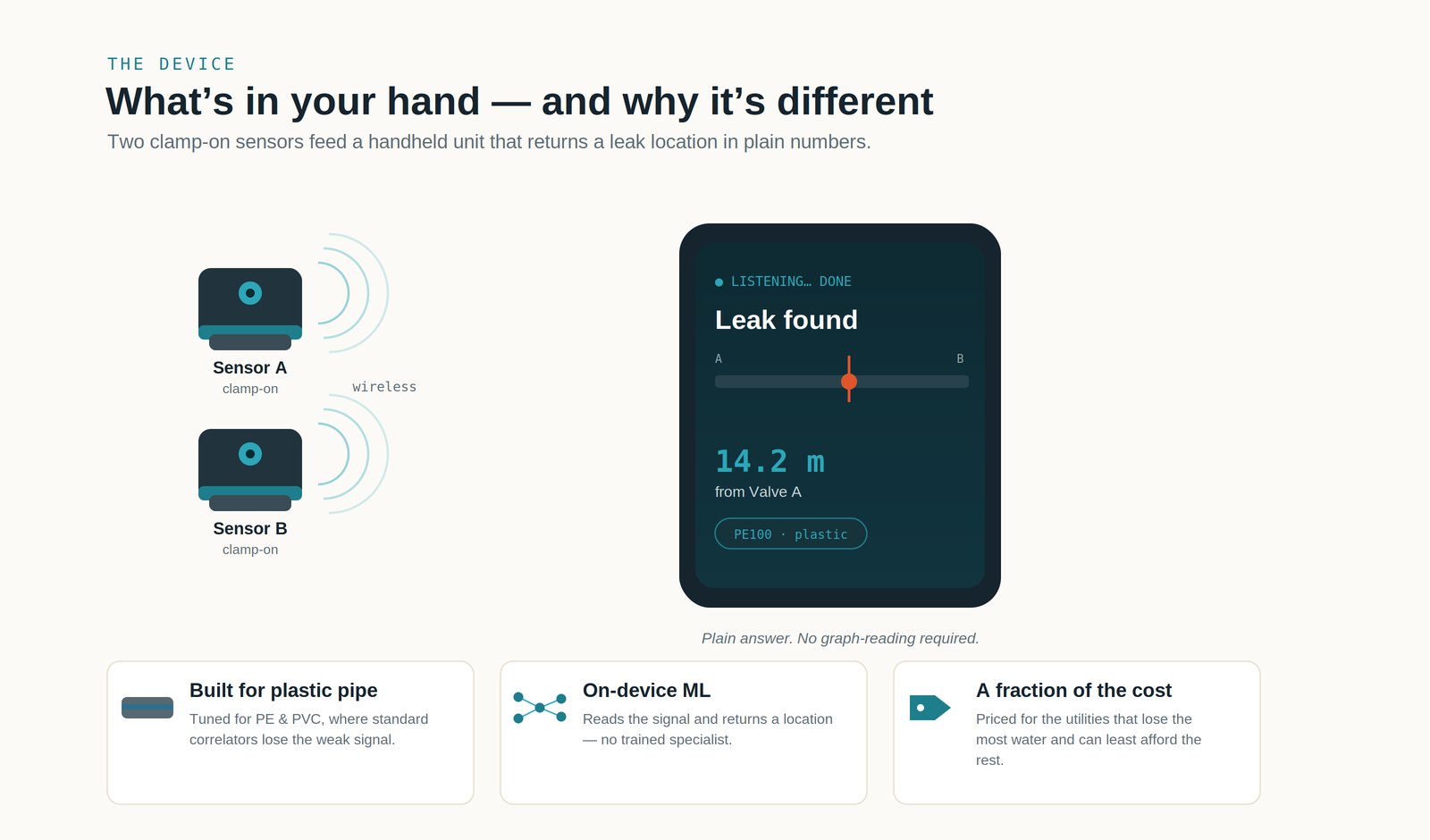
At a glance
- Stage
- R&D concept · simulation
- Method
- Cross-correlation + classifier
- Target
- Plastic pipe, where correlators fail
- Problem
- >40% non-revenue water
The physics
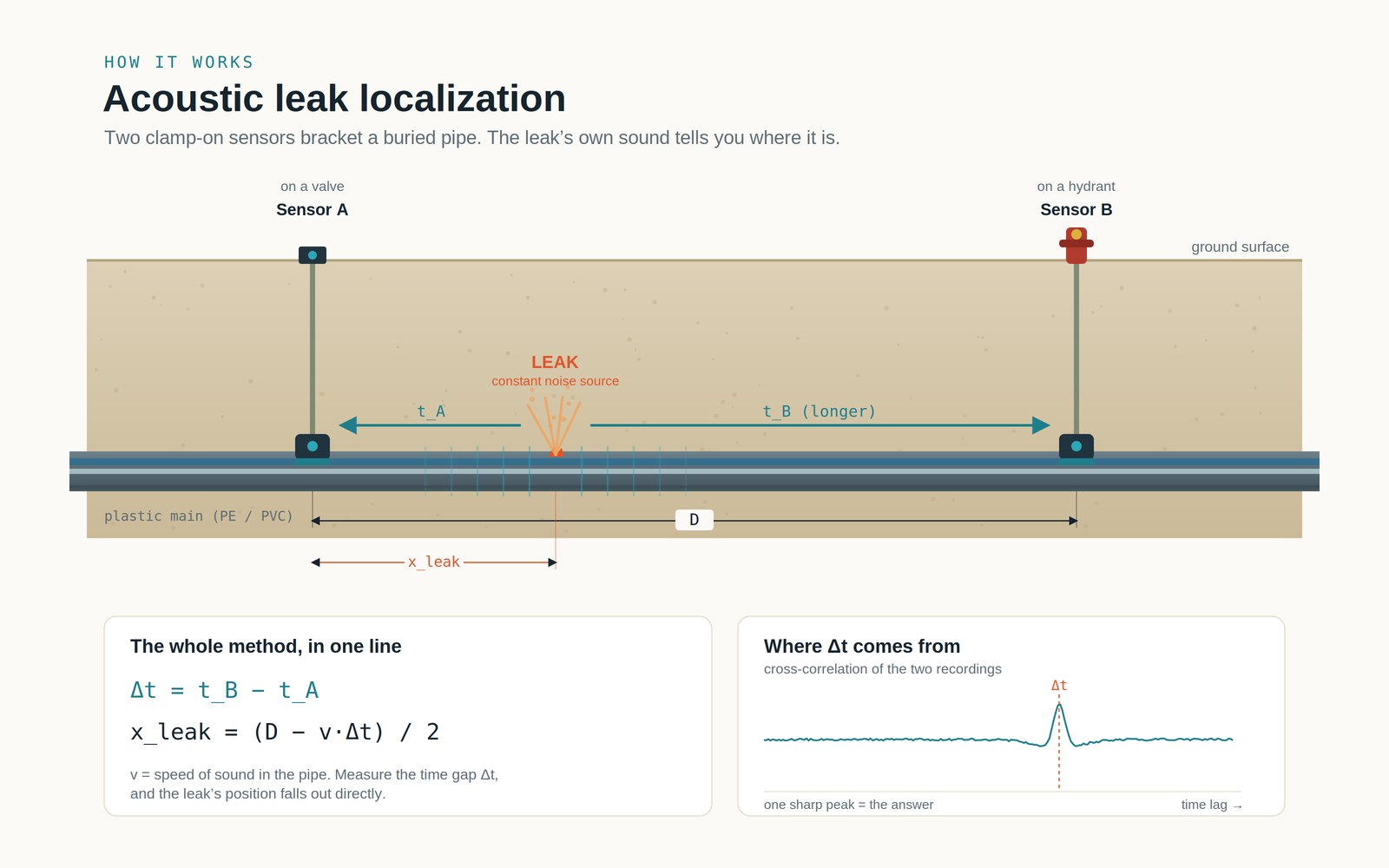
One equation does the locating
Plastic attenuates high frequencies hard, so what reaches the sensors is low-frequency and narrow-band, which makes that peak broad and shallow instead of sharp. Push the noise slider in the demo and you can watch it flatten until the classifier refuses to call it. That is the exact failure mode this design targets.
Code
What runs on the microcontroller
def locate(sig_a, sig_b, span_m, velocity, fs):
    corr = np.correlate(sig_a, sig_b, mode="full")
    lag  = corr.argmax() - (len(sig_a) - 1)
    dt   = lag / fs

    d = (span_m - velocity * dt) / 2.0
    return np.clip(d, 0, span_m), corr
def is_real_leak(corr, history):
    peak = corr.max()
    prominence = (peak - corr.mean()) / (corr.std() + 1e-9)

    # a real leak holds still; pump harmonics and traffic wander
    stable = np.std([h.position for h in history[-5:]]) < 1.5   # metres

    if prominence < 4.5 or not stable:
        return Verdict(False, "reposition sensors, peak not trustworthy")
    return Verdict(True, f"located, {prominence:.1f} sigma")
The operator gets a position and a verdict, not a plot to interpret.
Skills, in context
Where each one actually showed up